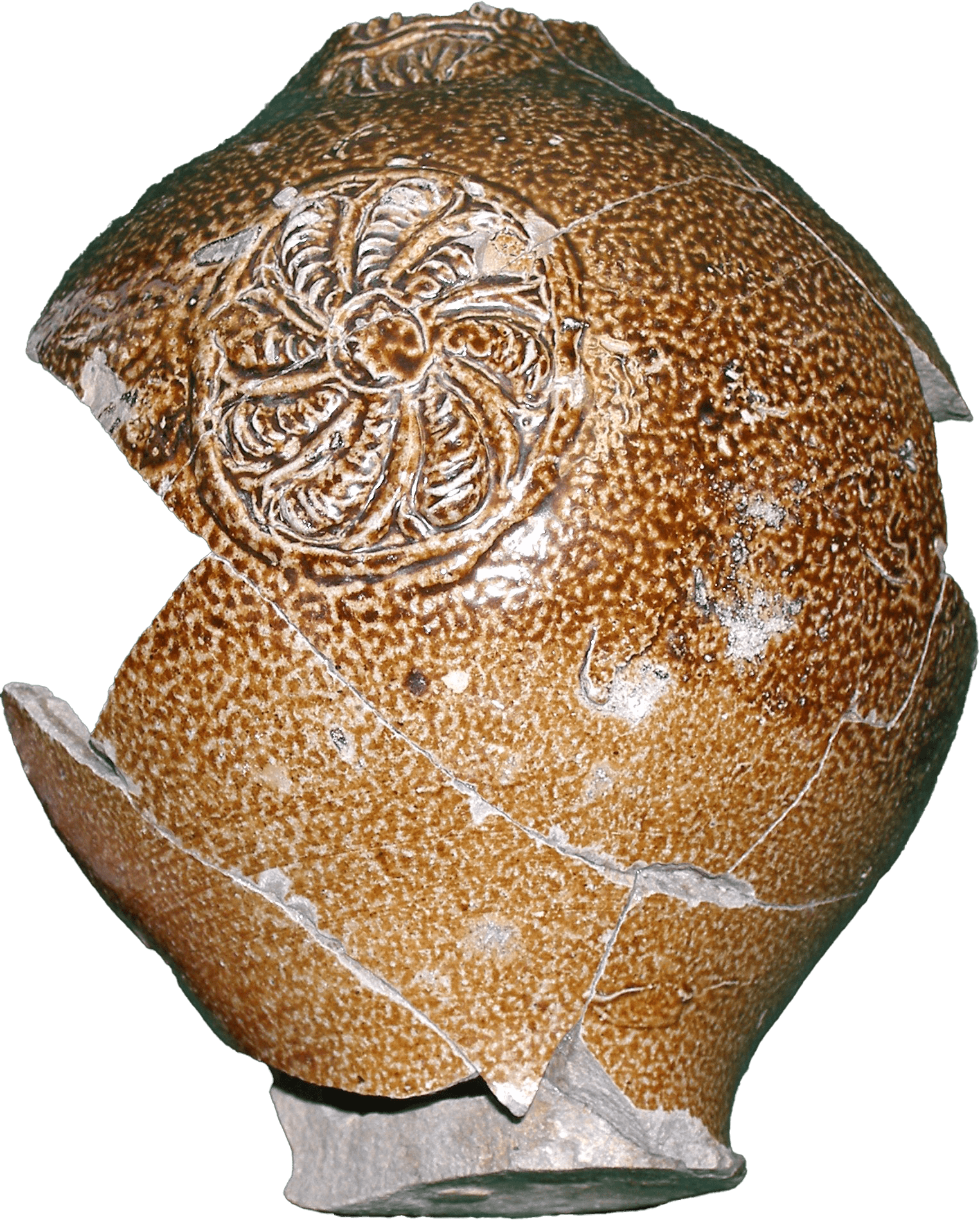
About this jug
Location:
Chlemoutsi (Kastro-Kyllini), Elis, Peloponnese
Greece
Long/Lat:
37.88911, 21.14323
Notes:
Chlemoutsi Castle is situated in the village of Kastro, in the Municipality of Andravida – Kyllini, of the Ilia Regional Unit, on the westernmost cape of the Peloponnese. Chlemoutsi is built on the summit of Chelonata Hill, the region’s highest point. From its prominent, strategic position, it dominates the entire plain of Ilia, while overseeing southern Achaia, the Ionian Sea and the coast of Aitoloakarnania.
The castle was established in 1220-1223 by Geoffrey I of Villehardouin. It was considered the strongest fortress of the Frankish principality of Achaea, which flourished under the rule of the Villehardouin family. To achieve its construction, Geoffrey clashed with the catholic clergy of Achaea and used the benefices. The new castle was named after its founders, Clermont; in Greek, the name is corrupted to Chlemoutsi. In later times, it was called Castel Tornese by the Venetians because they mistakenly believed the Frankish mint that produced tornesia (the principality’s currency) was located there.
Feature description: Fragment of a stoneware Bartmann jug with an ovoid body and a flat base. The vessel is
complete from the lower neck to the base; the upper neck and the handle are missing. The
exterior surface is covered with a dark brown engobe, except for the underside. The
interior surface is bare/unglazed. A stylised rosette is applied to the belly. The preserved
anthropomorphic facemask, stylistically consistent with late 17th-century production,
allows a confident chronological attribution.
This fragment is among the earliest documented instances of German stoneware in Greek archaeological contexts. Its presence at Chlemoutsi has been linked to the Venetian conquest of the Peloponnese in 1687 and the arrival of Western European goods through Venetian military and mercenary networks, including German soldiers serving in the Venetian army
Skartsis, S. (2012), Chlemoutsi Castle (Clermont Castel Tornese), NW Peloponnese: Its pottery and its relations with the west (13th-early 19th centuries), BAR International Series 2391, Oxford 2012, pp. 81-82 (ware 33, nos. 242-243, plate. 148)